


What is the Jeweler in Diablo 4?
The Jeweler is one of your essential endgame vendors, managing everything related to Gems, Sockets, Runes, and specialized crafting. Unlike the Blacksmith who handles gear upgrades, the Jeweler focuses exclusively on socketable items and jewelry creation.
You might be wondering: Why is the Jeweler so important? This vendor is critical for optimizing your gear through gem socketing, enabling Runewords, target-crafting Mythic Uniques, and generating Legendary jewelry. Without proper Jeweler usage, you’re leaving massive power gains on the table.
The Jeweler offers six core services:
- Salvage Gems – Convert unwanted gems into Gem Fragments
- Craft Gems – Combine Gem Fragments into higher-quality gems
- Unsocket – Remove gems or Runes from gear (free)
- Add Sockets – Create gem sockets on gear
- Rune Crafting – Target-craft Mythic Uniques and reforge Runes
- Jewelry Crafting – Create Jewelry Caches and convert Gem Fragment types
Where to Find the Jeweler 🗺️
You can find Jewelers in these locations across Sanctuary:
Major Cities
✓ Kyovashad (Fractured Peaks)
✓ Ked Bardu (Dry Steppes)
✓ Cerrigar (Scosglen)
✓ Zarbinzet (Hawezar)
✓ Gea Kul (Kehjistan)
✓ Kurast Bazaar (Nahantu – Vessel of Hatred)
Settlements
✓ Tree of Whispers (Hawezar)
💡 Navigation tip: Look for the Gem icon on your map or minimap. The Jeweler is marked distinctly from other vendors, making it easy to locate in any city.
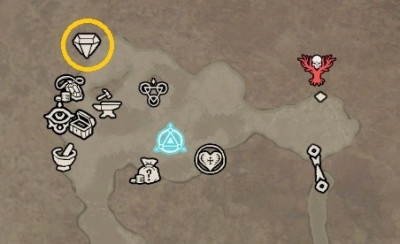
Understanding Gem Types and Stats 💎
Diablo 4 features 7 different gem types, each providing distinct stats depending on where they’re socketed (Weapon, Armor, or Jewelry).
Complete Gem Stats Table
| Gem Type | Weapon Bonus | Armor Bonus | Jewelry Bonus |
|---|---|---|---|
| Amethyst | +16.0% Damage Over Time | +4.0% Barrier Generation | +250 Shadow Resistance |
| Diamond | +20.0% Ultimate Damage | +7 All Stats | +35 Resistance to All Elements |
| Emerald | +24.0% Critical Strike Damage | +20 Dexterity | +250 Poison Resistance |
| Ruby | +30.0% Overpower Damage | +20 Strength | +250 Fire Resistance |
| Sapphire | +18.0% Vulnerable Damage | +20 Willpower | +250 Cold Resistance |
| Skull | +4 Life On Kill | +6.0% Healing Received | +250 Physical Resistance |
| Topaz | +20.0% Basic Damage | +20 Intelligence | +250 Lightning Resistance |
Note: These are base level (Level 15) stats. Higher quality gems provide proportionally increased values.
Gem Selection by Build Type
For Crit-based builds: Emerald in weapons (Crit Damage), Diamond in jewelry (All Res)
For DoT builds: Amethyst in weapons (DoT Damage), Sapphire in armor (Willpower for most casters)
For Tank builds: Skull in armor (Healing Received), Diamond in jewelry (All Res)
For Overpower builds: Ruby in weapons (Overpower Damage), Ruby in armor (Strength for most melee)
For Basic Skill builds: Topaz in weapons (Basic Damage), appropriate stat gem in armor
For Ultimate-focused builds: Diamond in weapons (Ultimate Damage), Diamond in jewelry (All Res)
For Vulnerable builds: Sapphire in weapons (Vulnerable Damage), class-specific stat in armor
Gem Quality Levels and Crafting Costs 📊
Gems come in 5 quality tiers, each requiring exponentially more resources:
Complete Crafting Cost Table
| Quality | Level Req | Gem Fragments | Forgotten Souls | Gold | Total Power Gain |
|---|---|---|---|---|---|
| Chipped | 1 | 10 | 0 | 1,000 | 20% base |
| Base | 15 | 100 | 0 | 10,000 | 100% base |
| Flawless | 20 | 1,000 | 0 | 100,000 | 125% base |
| Royal | 25 | 10,000 | 0 | 1,000,000 | 156% base |
| Grand | 30 | 100,000 | 30 | 10,000,000 | 188% base |
Cumulative Investment for Grand Gems
To craft one Grand gem from scratch (assuming you start with Gem Fragments), you need:
- 111,110 Gem Fragments (cumulative across all tiers)
- 30 Forgotten Souls
- 11,111,000 Gold
💡 Economic reality check: Grand gems are endgame investments. Most players use Royal gems (Level 25) for the majority of Season content, only upgrading to Grand for pushing highest Torment tiers or final build optimization.
How to Salvage Gems ♻️
Salvaging converts unwanted crafted gems back into Gem Fragments, allowing you to recycle resources without losing them permanently.
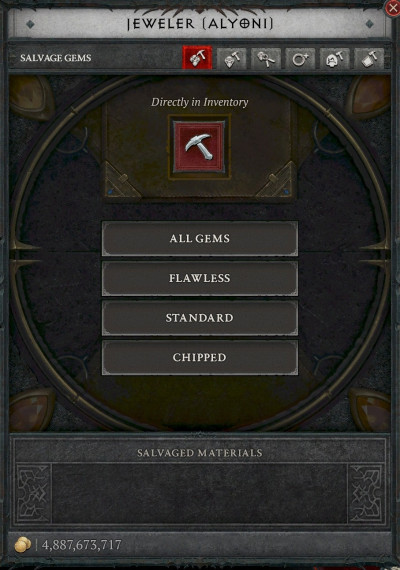
Salvaging Mechanics
✓ 100% Fragment Return – You get back ALL Gem Fragments used to create the gem
❌ No Gold Refund – Gold spent crafting is NOT returned
❌ No Forgotten Soul Refund – The 30 Forgotten Souls for Grand gems are NOT returned
✓ Inventory Only – “Salvage All” only affects gems in your inventory, not equipped or stashed gems
When to Salvage Gems
Salvage when:
- You have excess lower-tier gems (Chipped, Base) cluttering inventory
- You need Fragments to craft a different gem type
- You’re transitioning builds and no longer need specific gem types
- You have duplicate quality gems beyond what you need
Don’t salvage when:
- The gem is currently useful for an alt character
- You might respec your build soon
- You’re close to having enough materials for the next quality tier
- It’s a Grand gem (unless absolutely necessary – you lose 30 Forgotten Souls permanently)
⚠️ Critical warning: Salvaging a Grand gem returns 100,000 Gem Fragments but you permanently lose 30 Forgotten Souls and 10M Gold. Only salvage Grand gems if you’re 100% certain you won’t need that gem type again.
How to Craft Gems 🔨
Gem crafting at the Jeweler combines Gem Fragments with Gold (and Forgotten Souls for Grand) to create progressively stronger gems.
Step-by-Step Crafting Process
- Farm Gem Fragments – Obtained from salvaging gear, Infernal Hordes, Helltide, Nightmare Dungeons, World Bosses
- Visit the Jeweler – Navigate to “Craft Gems” option
- Select Gem Type – Choose from 7 gem types based on your build needs
- Choose Quality Tier – Select the quality level you can afford
- Confirm Craft – Pay materials and receive your gem
Efficient Crafting Strategy
For Beginners (Level 1-60):
- Craft Base gems (Level 15) only
- Don’t invest heavily until you have stable gear
- Focus on 2-3 gem types maximum for your main build
For Mid-Game (Level 60-80):
- Upgrade to Flawless gems (Level 20) for core gear pieces
- Start stockpiling Fragments for eventual Royal gems
- Diversify gem types as you experiment with builds
For Endgame (Level 80+):
- Craft Royal gems (Level 25) for all main gear sockets
- Only craft Grand gems (Level 30) for absolute BiS (Best in Slot) items you’ll never replace
- Maintain a reserve of Fragments for quick adaptations
💡 Resource management tip: Always keep at least 50,000 Gem Fragments of each type in reserve before crafting Grand gems. Build transitions happen, and you don’t want to be caught without resources.
How to Unsocket Gems and Runes 🔓
Unsocketing removes gems, Runes, or other socketables from gear without destroying them.
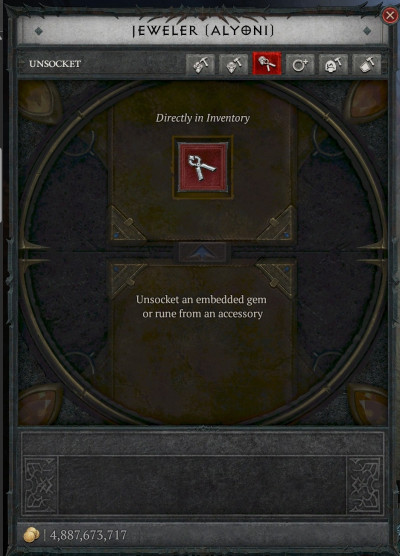
Unsocketing Key Facts
✓ Completely Free – No gold or material cost
✓ Non-Destructive – Unsocketed items return to your inventory intact
✓ Unnecessary for Replacement – Simply socket a new item to auto-unsocket the old one
✓ Required Before Vendor Sale – Always unsocket before selling to vendors (selling destroys socketed items permanently)
✓ Auto-Return on Salvage – Salvaging gear automatically returns socketed items to inventory
When to Actually Use Unsocket
You only need the Unsocket function when:
- Saving Gear Without Replacement – You want to keep the item but move gems/Runes to another character
- Pre-Trading Preparation – Removing your gems before trading gear to another player
- Inventory Management – Consolidating gems from multiple gear pieces you’re about to salvage (though salvage auto-returns them anyway)
❌ Common mistake: Players often manually unsocket before replacing gems. This is unnecessary – just drag your new gem onto the socket and it auto-replaces, returning the old gem to inventory.
How to Add Sockets to Items 🔧
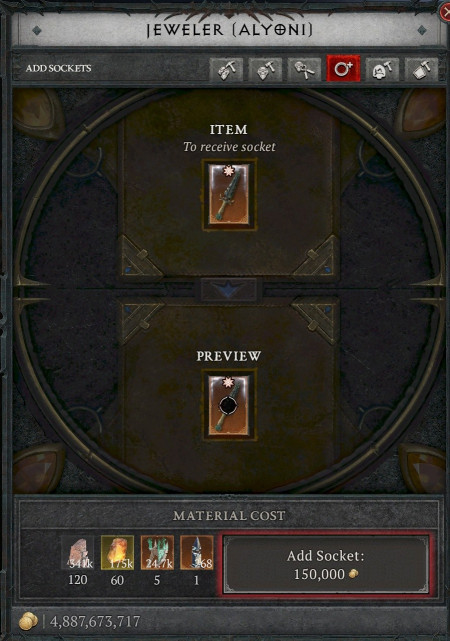
Adding Sockets creates new socket slots on gear that either has no sockets or hasn’t reached maximum socket capacity.
Maximum Socket Capacity by Gear Type
| Gear Type | Max Sockets |
|---|---|
| Helms | 2 |
| Chest Armor | 2 |
| Pants | 2 |
| 2-Handed Weapons | 2 |
| Amulets | 1 |
| Rings | 1 |
| Totems | 1 |
| Foci | 1 |
| Shields | 1 |
| 1-Handed Weapons | 1 |
| Gloves | 0 (Cannot socket) |
| Boots | 0 (Cannot socket) |
⚠️ Important limitation: Gloves and Boots cannot have sockets added. This is a fixed game restriction.
Required Materials for Adding Sockets
Materials needed depend on gear type (Weapon/Armor/Jewelry) and item level:
Common Materials:
- Iron Chunk – For Weapons and Jewelry
- Rawhide – For Armor
Rare Materials (all types):
- Veiled Crystal – Universal requirement
Legendary Materials (gear-specific):
- Baleful Fragment – Legendary Weapons
- Coiling Ward – Legendary Armor
- Abstruse Sigil – Legendary Jewelry
Ancestral Materials:
- Scattered Prism – Required for Ancestral (Level 60+) gear
Where to Farm Socket Materials
Iron Chunk & Rawhide:
- Salvaging weapons/armor at Blacksmith
- Tree of Whispers caches
- Legion Events
- Infernal Hordes
- Elite monster drops
Veiled Crystal:
- Salvaging Rare, Legendary, and Unique gear
- Tree of Whispers caches
- Legion Events
- High-tier Nightmare Dungeons
Specialized Legendary Materials:
- Salvaging Legendary/Unique/Mythic gear of corresponding type
- Tree of Whispers caches
Scattered Prism:
- World Bosses
- Infernal Hordes (Spoils of Equipment)
- Kurast Undercity
- Dark Citadel
- Bartering at Mercenary Den
💡 Farming priority: Scattered Prisms are the bottleneck for endgame socketing. Focus on World Boss attendance and Infernal Hordes for steady Prism accumulation.
Mythic Unique Target Crafting at Jeweler 🎯
The Jeweler offers target-crafting of specific Mythic Uniques, unlike the Blacksmith’s random Mythic Cache.
Crafting Requirements
Every targeted Mythic Unique requires:
- 2x Resplendent Spark
- 18 specific Runes (6 Legendary, 6 Rare, 6 Magic)
- 5,000 Gold
Key Advantages Over Blacksmith
✓ Guaranteed Specific Item – No RNG, get exactly what you want
✓ Class-Specific Access – Can craft class-specific Mythics for your character
✓ Lower Spark Cost – 2 Sparks vs 4 Sparks for random Mythic Cache
✓ Rune Utilization – Puts excess Runes to valuable use
❌ Limitation: You cannot see class-specific Mythic Uniques for classes other than your current character.
Strategic Comparison
Jeweler Target Crafting (2 Sparks + 18 Runes):
- Perfect when you need 1-2 specific Mythics
- More efficient if you have abundant Runes
- Ideal for chasing BiS items
Blacksmith Random Cache (4 Sparks):
- Better for getting multiple different Mythics
- No Rune farming requirement
- Good for early Mythic acquisition
Recommendation: If you’re farming Runes regularly (Kurast Undercity, World Bosses), use Jeweler target crafting for your most important 1-2 Mythics, then use Blacksmith for filling out the rest of your Mythic collection.
For complete Rune requirements per Mythic, see the detailed table in my Runecrafting guide.
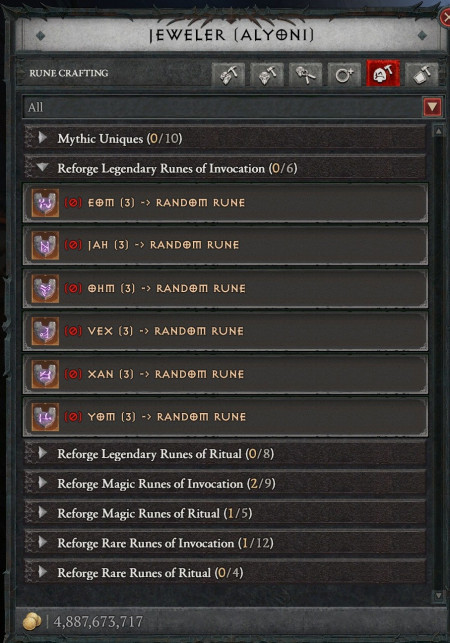
Rune Reforging – Converting Unwanted Runes 🔄
Rune Reforging trades 3 identical unwanted Runes for a chance at a different Rune of the same or higher quality.
Reforging Mechanics
Cost: 4,000 Gold + 3 Identical Runes
Outcomes by Quality:
| Source Runes | Result Chance | Possible Upgrade |
|---|---|---|
| 3x Magic Runes | 85% Magic Rune, 15% Rare Rune | 15% upgrade chance |
| 3x Rare Runes | 85% Rare Rune, 15% Legendary Rune | 15% upgrade chance |
| 3x Legendary Runes | 100% Legendary Rune | No upgrade possible |
Critical Details:
- Type is Random – You might get Ritual or Invocation regardless of source type
- Specific Rune is Random – No control over which Rune you receive
- Duplicate Possible – You might get the same Rune you’re trying to reforge
When to Reforge Runes
Reforge when:
- You have 10+ copies of a Rune you never use
- You’re targeting specific Runes for Mythic crafting
- You want to gamble Magic/Rare Runes for Legendary upgrades
- You have excess Runes after completing your Mythic needs
Don’t reforge when:
- You have less than 6 copies (safety buffer for Mythic crafting)
- The Rune is commonly used in meta builds
- You’re low on Gold (4,000 per attempt adds up)
- You’re targeting a specific Rune (reforging is pure RNG)
💡 Economic consideration: At 4,000 Gold per reforge, attempting to target a specific Legendary Rune could cost 100,000+ Gold depending on RNG. Only reforge if you truly don’t need the source Runes for anything else.
Jewelry Cache Crafting 💍
Jewelry Caches create Legendary (and rarely Unique) Amulets or Rings, providing an alternative to farming for jewelry drops.
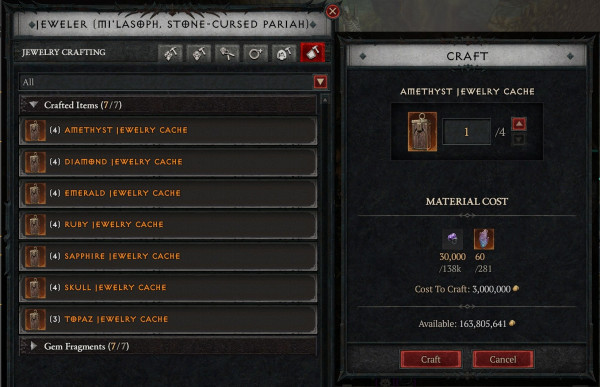
Crafting Requirements
Per Cache:
- 30,000 Gem Fragments (any combination of types)
- 60 Forgotten Souls
- 3,000,000 Gold
Level Requirement: Level 60 (both to create and to open)
Jewelry Cache Mechanics
✓ Random Type – Amulet or Ring determined randomly
✓ Random Quality – Mostly Legendary, rarely Unique
✓ Class-Based Aspects – Class-specific Aspects/Uniques match whoever opens the cache, not who created it
✓ Gem Fragment Type Irrelevant – Doesn’t matter which Gem Fragment types you use for the 30,000 requirement
Strategic Analysis
Cache Value Assessment:
Pros:
- Targeted jewelry farming without RNG mob grinding
- Can stockpile caches for future characters
- Useful for filling out jewelry collection early season
Cons:
- Extremely expensive (3M Gold per cache)
- Random results still require Enchanting for perfect rolls
- Gem Fragments might be better spent on Grand gems
- 60 Forgotten Souls per cache is steep
Recommendation: Jewelry Caches are situationally useful but not efficient compared to targeted Helltide/Nightmare Dungeon farming for jewelry. Only craft them if you have massive excess resources and need jewelry immediately without time to farm.
💡 Alt character strategy: Craft Jewelry Caches on your main character (who has abundant resources), then open them on your alt to get class-specific jewelry for that alt’s build. This accelerates alt progression significantly.
Gem Fragment Conversion 🔄
Gem Fragment Conversion lets you trade combinations of unwanted Fragment types for Fragments you actually need.
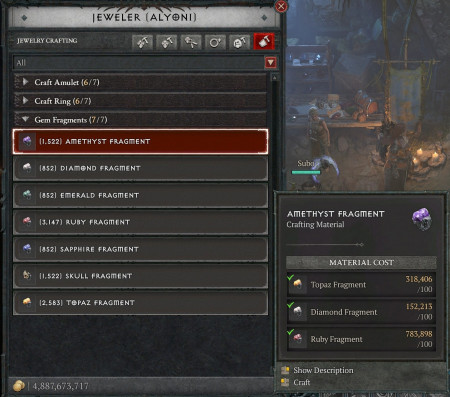
Conversion Ratio
Trade: 100 Fragments each of 3 different types (300 total) Receive: 200 Fragments of 1 chosen type
Example: Trade 100 Topaz + 100 Diamond + 100 Ruby Fragments → Receive 200 Amethyst Fragments
Conversion Efficiency Analysis
Input: 300 Fragments Output: 200 Fragments Loss: 100 Fragments (33% conversion tax)
This makes conversion inefficient unless you truly have no use for the source Fragment types.
When to Convert Fragments
Convert when:
- You have 50,000+ Fragments of types you never use
- You’re 10,000+ Fragments short of crafting a Grand gem you need urgently
- Your build exclusively uses 1-2 gem types and you’ll never need the others
- You’re approaching inventory limits with excess Fragments
Don’t convert when:
- You might change builds soon
- The Fragment types are used in important Incenses or Elixirs (check Alchemist first)
- You have alt characters that might need different gem types
- The 33% loss would hurt your overall Fragment reserves
⚠️ Alchemist warning: Many high-tier Incenses and Elixirs require specific Gem Fragment types. Always check your Alchemist recipes before mass-converting Fragments, or you might lock yourself out of important consumables.
Best Practices for Jeweler Usage ✓
✓ Prioritize Royal Gems – Grand gems are for absolute BiS items only due to massive cost
✓ Always Unsocket Before Vendor Sales – Selling gear with sockets destroys them forever
✓ Farm Scattered Prisms Consistently – World Bosses and Infernal Hordes are your best sources
✓ Keep 6+ Rune Copies – Don’t reforge Runes needed for potential Mythic crafting
✓ Salvage Strategically – Lower-tier gems salvage freely, Grand gems only in emergencies
✓ Check Alchemist Before Converting – Don’t lose Fragments needed for Incenses/Elixirs
✓ Socket Core Gear First – Prioritize weapons and chest armor before accessories
✓ Maintain Fragment Reserves – Keep 50,000+ Fragments per type for build flexibility
Common Jeweler Mistakes ❌
❌ Crafting Grand Gems Too Early – Wait until you have permanent BiS gear
❌ Selling Socketed Gear to Vendors – Always unsocket or salvage instead
❌ Ignoring Scattered Prism Farming – You’ll hit a wall socketing Ancestral gear without them
❌ Mass Converting Fragments Without Planning – 33% loss hurts, and you might need those types later
❌ Reforging Last 6 Runes – Always keep safety buffer for Mythic crafting
❌ Jewelry Cache Spam – 3M Gold per cache is usually better spent elsewhere
❌ Forgetting Salvage Returns 100% – Players hoard low-tier gems instead of salvaging for Fragments ❌ Not Checking Material Requirements – Running out of Veiled Crystals mid-socketing is frustrating
Advanced Jeweler Strategies 🧠
Strategy 1: Fragment Banking System
Maintain minimum reserves of each Fragment type:
- 50,000 Fragments – Emergency buffer for any gem type
- 100,000 Fragments – Comfortable reserve for Grand gem crafting
- 200,000+ Fragments – Excess available for conversion or Jewelry Caches
This prevents resource bottlenecks when build shifts happen.
Strategy 2: Staged Gem Upgrades
Don’t rush to Grand gems. Instead:
- Phase 1 (Level 60-80): Flawless gems in all gear
- Phase 2 (Level 80-100): Royal gems in Weapon + Chest + Pants
- Phase 3 (Level 100+): Royal gems in all remaining gear
- Phase 4 (Pushing Torment IV): Grand gems ONLY in absolutely permanent BiS items
This conserves Forgotten Souls and Gold for other critical upgrades.
Strategy 3: Mythic Crafting Priority Queue
Rank Mythic Uniques by importance to your build:
Tier 1 (Craft First): Build-defining Mythics (Harlequin Crest, Andariel’s Visage)
Tier 2 (Craft Second): Strong but not essential (Tyrael’s Might, Melted Heart)
Tier 3 (Craft Eventually): Nice-to-have (The Grandfather, Doombringer)
Farm Runes for Tier 1, then Tier 2, ignoring Tier 3 until excess Sparks/Runes accumulate.
Strategy 4: Alt Character Gem Sharing
Craft high-quality gems on your main character (who has abundant resources), then:
- Unsocket gems from main’s gear
- Transfer to alt character via Stash
- Socket into alt’s gear for instant power boost
- Re-craft gems for main using accumulated Fragments
This dramatically accelerates alt progression without duplicating expensive crafts.
Strategy 5: Scattered Prism Acquisition Loop
Establish a daily Prism farming routine:
- World Boss attendance (3-4x per day) – 15 minutes total
- Infernal Hordes (2-3 runs) – 30 minutes, select Spoils of Equipment
- Kurast Undercity (1-2 runs with Tribute) – 20 minutes
- Mercenary Den bartering (daily reset check) – 5 minutes
Expected yield: 5-10 Scattered Prisms per day, enough to socket 1-2 Ancestral items daily.
Integration with Other Crafting Systems 🔗
Jeweler + Blacksmith
Socket before Masterworking – Add sockets to gear first, then Masterwork, to avoid wasting Masterwork materials on replaced gear.
Jeweler + Occultist
Enchant before socketing expensive gems – Finalize your affixes with the Occultist before investing Royal/Grand gems, avoiding wasted resources on re-enchanted items.
Jeweler + Alchemist
Check Incense/Elixir needs before Fragment conversion – Many consumables require specific Gem Fragment types. Convert only true excess.
Jeweler + Runecrafting
Prioritize Rune reforging for Mythic crafting – Target the 18 Runes needed for your desired Mythic before reforging for Runeword experimentation.
Economic Analysis – Is It Worth It? 💰
Grand Gem ROI Calculation
Investment per Grand Gem:
- 100,000 Gem Fragments
- 30 Forgotten Souls
- 10,000,000 Gold
Power Gain: ~25% increase over Royal gem
Break-Even: Only worth it for items you’ll use for 500+ hours or entire season
Verdict: Grand gems are luxury upgrades, not necessities. Royal gems provide 95% of the benefit at 10% of the cost.
Jewelry Cache ROI Calculation
Investment per Cache:
- 30,000 Gem Fragments
- 60 Forgotten Souls
- 3,000,000 Gold
Expected Value: 1 Legendary Ring/Amulet (rarely Unique)
Alternative: Farm Helltide Mystery Chests for 5 minutes, get equivalent jewelry for free
Verdict: Jewelry Caches are inefficient unless you have massive excess resources and zero time to farm.
Rune Reforging ROI Calculation
Investment per Attempt:
- 3 Runes (same type)
- 4,000 Gold
Expected Outcome: 85-100% chance for same-quality Rune, 15% upgrade chance (Magic/Rare only)
Break-Even: Reforging 10 unwanted Runes costs 40,000 Gold + 30 Runes, might yield 0 useful results
Verdict: Rune reforging is high variance gambling. Only do it with true excess Runes you’ll never use.
FAQ
Q: Can I salvage Grand gems to get my Forgotten Souls back?
A: No, salvaging returns 100% of Gem Fragments but does not refund the Gold or 30 Forgotten Souls invested. Only salvage Grand gems if absolutely necessary.
Q: What’s the fastest way to farm Gem Fragments?
A: Run Infernal Hordes and select Spoils of Materials chests, combined with salvaging all unwanted gear from Helltide and Nightmare Dungeons. Expect 10,000-20,000 Fragments per hour.
Q: Do I need to manually unsocket gems before replacing them?
A: No, simply drag a new gem onto an existing socket and it automatically replaces the old one, returning it to your inventory. Manual unsocketing is only needed when removing without replacement.
Q: Can Gloves and Boots have sockets?
A: No, Gloves and Boots cannot have sockets added. This is a permanent game restriction.
Q: What’s the best gem for weapons?
A: Depends on your build – Emerald (Crit Damage) for crit builds, Sapphire (Vulnerable Damage) for Vulnerable builds, Ruby (Overpower Damage) for Overpower builds, Diamond (Ultimate Damage) for Ultimate-focused builds.
Q: Are Jewelry Caches worth crafting?
A: Generally no – they cost 3M Gold + 60 Forgotten Souls + 30k Fragments for a random Legendary jewelry piece. Farming Helltide Mystery Chests is more efficient unless you have massive excess resources.
Q: How many Scattered Prisms do I need per Ancestral item?
A: It varies by item type and how many sockets you’re adding, but expect 1-3 Scattered Prisms per Ancestral socket. Budget 10-15 Prisms to fully socket a complete set of Ancestral gear.
Q: Should I convert Gem Fragments to get the type I need?
A: Only if you have 50,000+ Fragments of types you’ll never use. The 33% conversion loss is steep, and many Alchemist recipes need specific Fragment types. Always check your Incense/Elixir needs first.
Q: Can I target-craft any Mythic Unique at the Jeweler?
A: Yes, but you can only see and craft Mythics for your current class (for class-specific Mythics). Universal Mythics are visible for all classes.
Q: What’s the difference between Jeweler Mythic crafting and Blacksmith Mythic Caches?
A: Jeweler costs 2 Resplendent Sparks + 18 specific Runes + 5k Gold for a guaranteed specific Mythic. Blacksmith costs 4 Sparks for a random Mythic. Use Jeweler when you have Runes and need 1-2 specific items.